Free Employee Handbook Document for Florida State
Document Sample
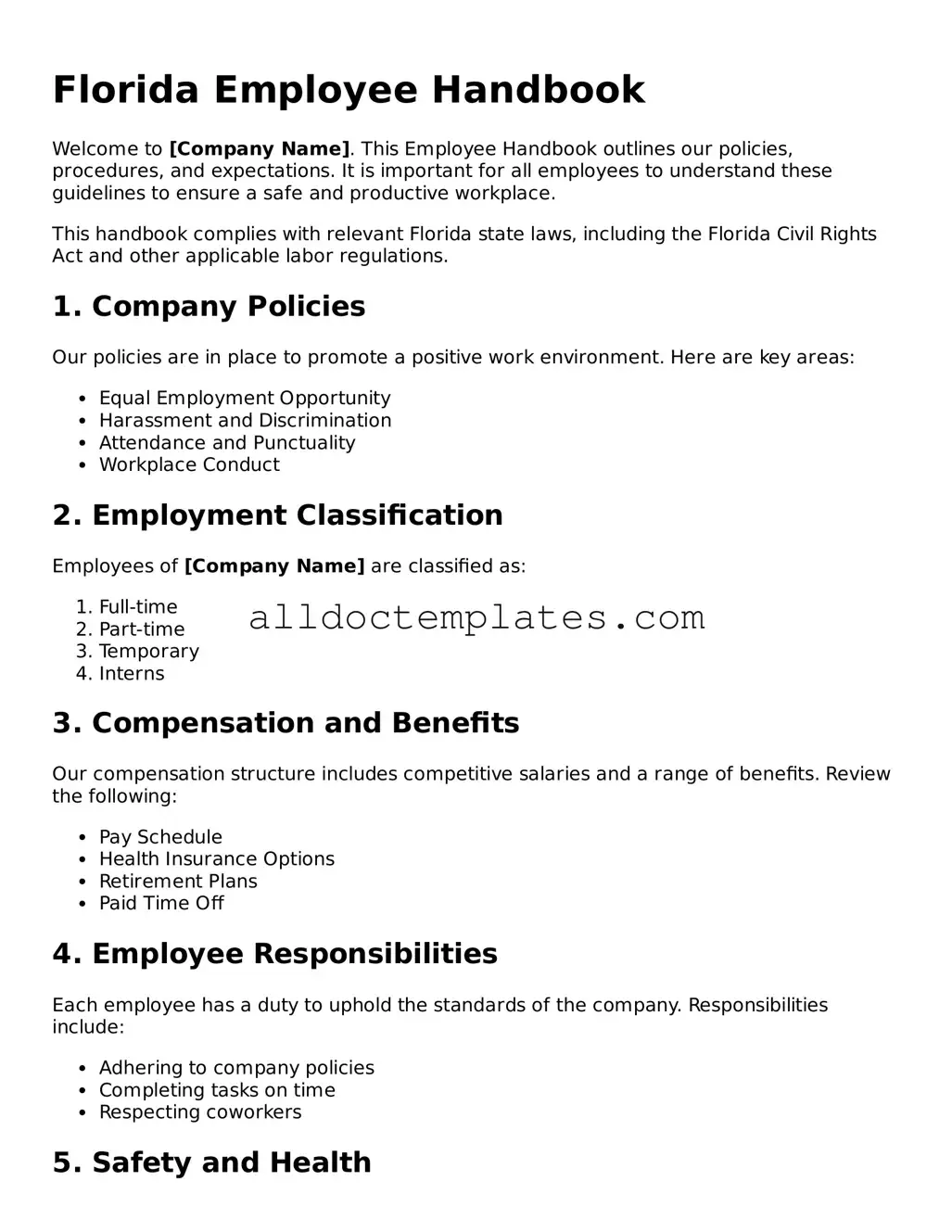
Florida Employee Handbook
Welcome to [Company Name]. This Employee Handbook outlines our policies, procedures, and expectations. It is important for all employees to understand these guidelines to ensure a safe and productive workplace.
This handbook complies with relevant Florida state laws, including the Florida Civil Rights Act and other applicable labor regulations.
1. Company Policies
Our policies are in place to promote a positive work environment. Here are key areas:
- Equal Employment Opportunity
- Harassment and Discrimination
- Attendance and Punctuality
- Workplace Conduct
2. Employment Classification
Employees of [Company Name] are classified as:
- Full-time
- Part-time
- Temporary
- Interns
3. Compensation and Benefits
Our compensation structure includes competitive salaries and a range of benefits. Review the following:
- Pay Schedule
- Health Insurance Options
- Retirement Plans
- Paid Time Off
4. Employee Responsibilities
Each employee has a duty to uphold the standards of the company. Responsibilities include:
- Adhering to company policies
- Completing tasks on time
- Respecting coworkers
5. Safety and Health
Your safety is our priority. Follow all safety guidelines to ensure a secure working environment:
- Report any unsafe conditions immediately.
- Use equipment properly and follow instructions.
- Participate in safety training sessions.
6. Grievance Procedure
If you have a concern, please follow these steps:
- Discuss the issue with your immediate supervisor.
- If unresolved, submit a written complaint to HR.
- HR will investigate and respond.
7. Acknowledgment of Receipt
Please sign below to acknowledge that you have received and read this Employee Handbook:
__________________________
Employee Name
__________________________
Date
Form Data
| Fact Name | Details |
|---|---|
| Purpose | The Florida Employee Handbook serves as a guide for employees regarding company policies, procedures, and expectations. |
| Legal Requirement | While not legally required, having an employee handbook is highly recommended to clarify workplace policies. |
| Governing Laws | Florida labor laws, including the Florida Statutes Title XXXI, Chapter 448, provide guidelines for employment practices. |
| Content Recommendations | It should include sections on equal employment opportunity, anti-discrimination policies, and employee benefits. |
| Employee Acknowledgment | Employers often require employees to sign an acknowledgment form confirming they have received and understood the handbook. |
| Updates | Handbooks should be reviewed and updated regularly to reflect changes in laws or company policies. |
| Dispute Resolution | Including a dispute resolution process can help address conflicts before they escalate into legal issues. |
Florida Employee Handbook - Usage Guidelines
After obtaining the Florida Employee Handbook form, it is important to complete it accurately to ensure compliance with company policies. Follow the steps outlined below to fill out the form correctly.
- Begin by entering your full name in the designated field at the top of the form.
- Provide your employee identification number, if applicable, in the next section.
- Fill in your job title and department to clarify your position within the organization.
- Indicate the date of hire to establish your employment timeline.
- Review the company policies listed on the form carefully. Acknowledge your understanding by signing where indicated.
- Print your name below your signature to ensure clarity.
- Submit the completed form to your human resources representative or designated supervisor.
Some Other Employee Handbook State Templates
New York State Employee Handbook - It helps to promote a culture of respect and integrity within the organization.
Create Employee Handbook - Guidelines on vacation accrual and usage are outlined.
California Employee Handbook Template - The handbook includes critical information pertaining to workplace diversity and inclusion.
To further clarify the importance of the document, you can find the necessary details and a template for the Utah Mobile Home Bill of Sale at https://mobilehomebillofsale.com/blank-utah-mobile-home-bill-of-sale/, which can help ensure a smooth transfer of ownership in compliance with state regulations.
Hiring Your First Employee - The document covers policies on personal calls and email use at work.
Dos and Don'ts
When filling out the Florida Employee Handbook form, it is important to approach the task thoughtfully. Here is a list of things you should and shouldn't do to ensure the process goes smoothly.
- Do read the entire handbook carefully before filling out the form.
- Do provide accurate and truthful information.
- Do ask questions if you are unsure about any section of the form.
- Do keep a copy of the completed form for your records.
- Don't rush through the form; take your time to ensure accuracy.
- Don't leave any required fields blank.
- Don't use slang or informal language when filling out the form.
- Don't hesitate to seek assistance from HR if needed.
Common mistakes
-
Not reading the entire handbook thoroughly. Understanding the policies and procedures is crucial before signing the form.
-
Failing to provide accurate personal information. Double-check names, addresses, and contact details to ensure they are correct.
-
Ignoring the deadline for submission. Late submissions can lead to complications or delays in employment processes.
-
Overlooking the signature requirement. Ensure that all necessary signatures are provided where indicated.
-
Not asking questions about unclear policies. If something is confusing, it’s important to seek clarification before proceeding.
-
Neglecting to keep a copy of the completed form. Retaining a copy can be helpful for future reference.
-
Assuming all information is the same as previous employment. Policies may differ significantly from one employer to another.
-
Rushing through the form. Taking time to fill it out carefully can prevent mistakes and misunderstandings.
-
Failing to review the company’s values and mission statement. Understanding these can enhance alignment with company culture.