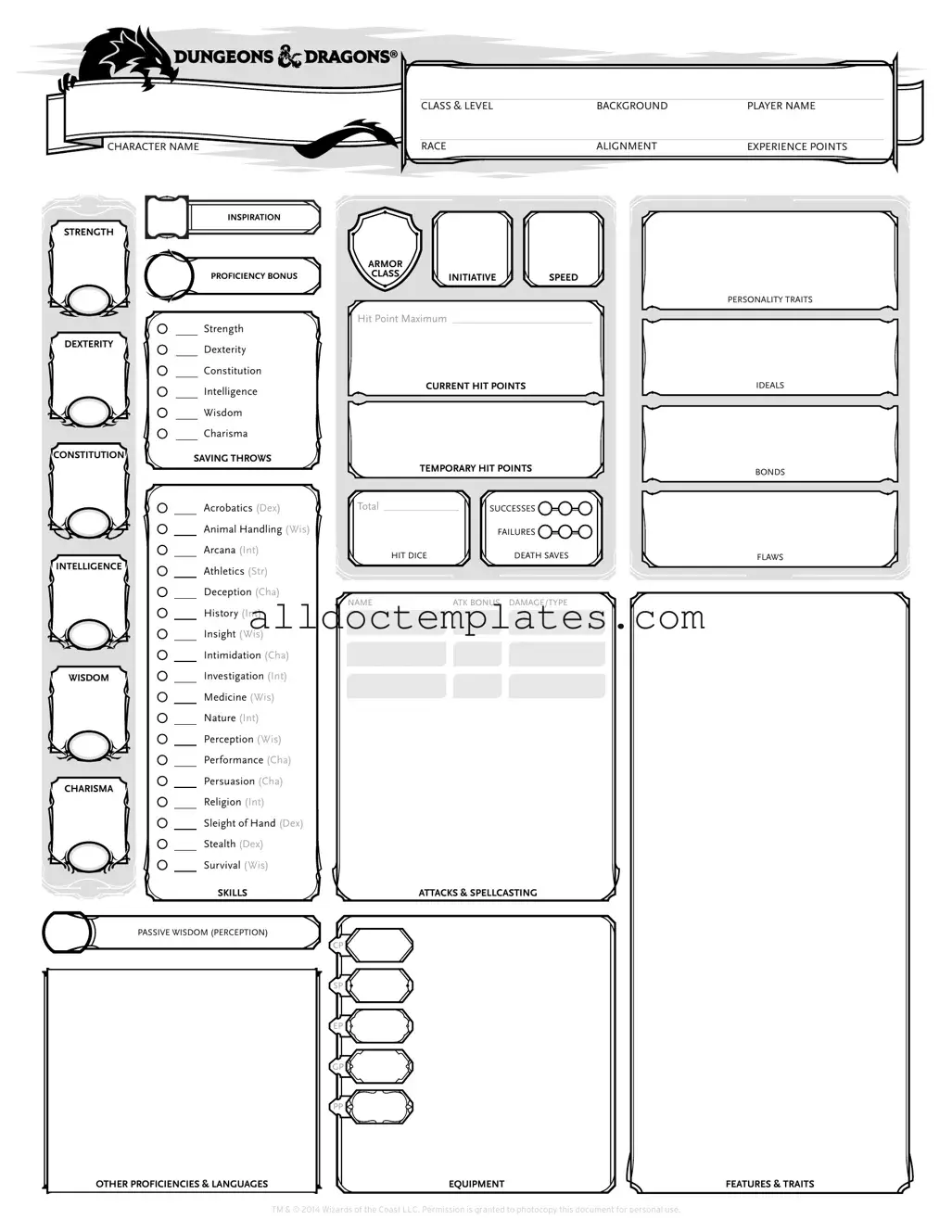
Fill in a Valid Dnd Character Sheet Form
Document Sample
|
CLASS & LEVEL |
BACKGROUND |
PLAYER NAME |
CHARACTER NAME |
RACE |
ALIGNMENT |
EXPERIENCE POINTS |
INSPIRATION
STRENGTH
|
ARMOR |
|
|
PROFICIENCY BONUS |
CLASS |
INITIATIVE |
SPEED |
|
PERSONALITY TRAITS
DEXTERITY
CONSTITUTION
INTELLIGENCE
WISDOM
CHARISMA
Strength
Dexterity
Constitution
Intelligence
Wisdom
Charisma
SAVING THROWS
Acrobatics (Dex)
Animal Handling (Wis)
Arcana (Int)
Athletics (Str)
Deception (Cha)
History (Int)
Insight (Wis)
Intimidation (Cha)
Investigation (Int)
Medicine (Wis)
Nature (Int)
Perception (Wis)
Performance (Cha)
Persuasion (Cha)
Religion (Int)
Sleight of Hand (Dex)
Stealth (Dex)
Survival (Wis)
SKILLS
PASSIVE WISDOM (PERCEPTION)
Hit Point Maximum
CURRENT HIT POINTS
TEMPORARY HIT POINTS
Total |
|
|
SUCCESSES |
|
|
|
FAILURES |
|
HIT DICE |
|
DEATH SAVES |
NAME |
ATK BONUS DAMAGE/TYPE |
||
ATTACKS & SPELLCASTING
CP 
SP 
EP 
GP 
PP 
IDEALS
BONDS
FLAWS
OTHER PROFICIENCIES & LANGUAGES |
EQUIPMENT |
FEATURES & TRAITS |
TM & © 2014 Wizards of the Coast LLC. Permission is granted to photocopy this document for personal use.
|
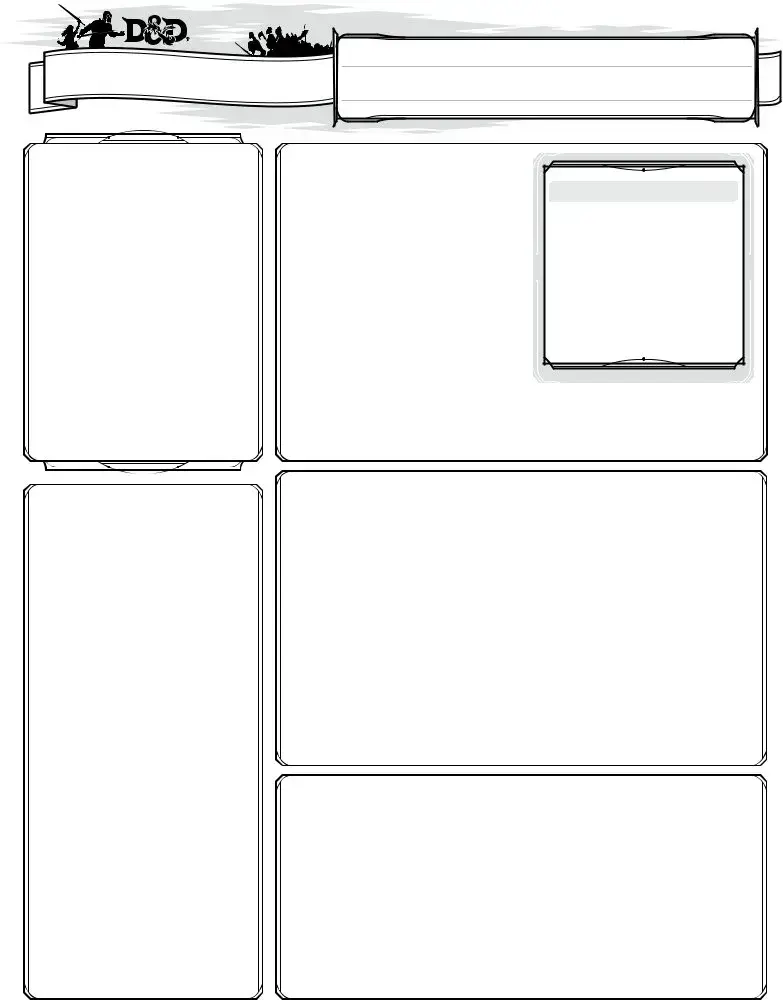
AGE |
HEIGHT |
WEIGHT |
CHARACTER NAME |
EYES |
SKIN |
HAIR |
|
|
|
NAME |
SYMBOL
CHARACTER APPEARANCE |
ALLIES & ORGANIZATIONS |
ADDITIONAL FEATURES & TRAITS
CHARACTER BACKSTORY |
TREASURE |
TM & © 2014 Wizards of the Coast LLC. Permission is granted to photocopy this document for personal use.
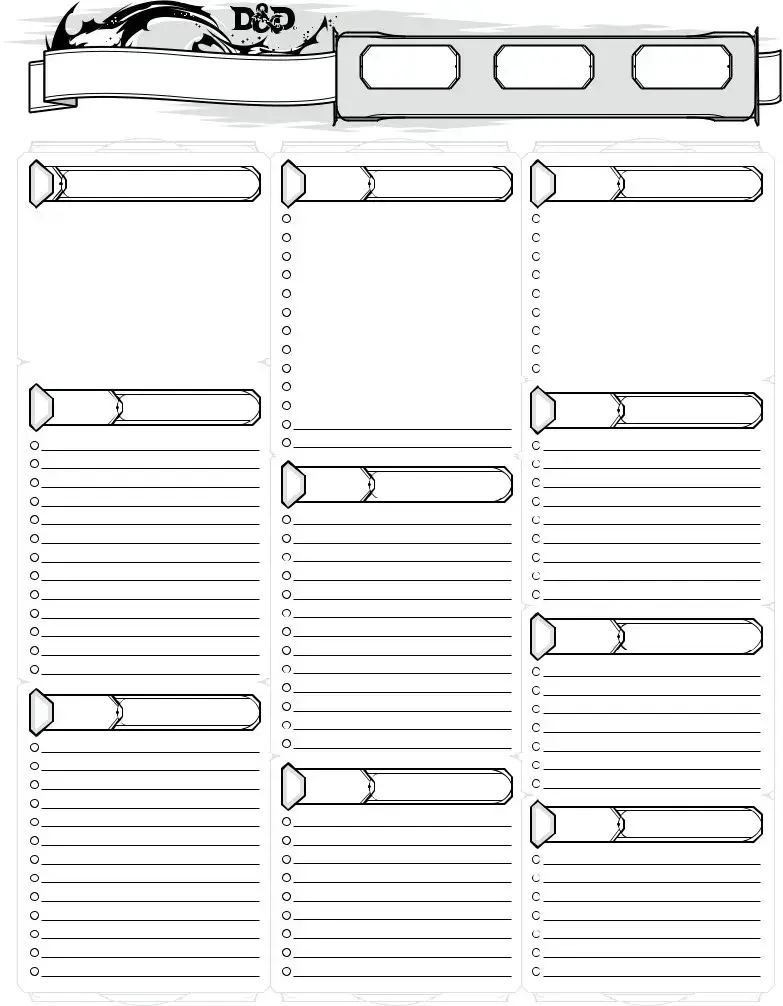
SPELLCASTING |
SPELLCASTING |
SPELL SAVE DC |
SPELL ATTACK |
ABILITY |
|
BONUS |
|
CLASS |
|
|
|
0 |
CANTRIPS |
3 |
6 |
||
|
|
|
|
|
|
|
|
|
|
|
|
|
|
|
|
|
|
|
|
|
|
|
|
|
|
|
|
|
|
|
|
|
|
|
|
|
|
|
|
|
|
|
|
|
|
|
|
|
|
|
|
|
|
|
|
|
|
|
|
|
|
|
|
|
|
|
|
|
|
|
|
|
|
|
|
|
|
|
|
|
|
|
|
|
|
|
|
|
|
|
|
|
|
|
|
SPELL |
|
|
|
|
LEVEL SLOTS TOTAL |
SLOTS EXPENDED |
|||
1 |
|
|
7 |
|
|
||||
PAR |
|
E |
E |
PR |
D |
SPELL NAME
4
SPELLS KNOWN
8
2
5
9
TM & © 2014 Wizards of the Coast LLC. Permission is granted to photocopy this document for personal use.
Document Information
| Fact Name | Description |
|---|---|
| Character Basics | The character sheet includes essential information such as name, race, class, and background. This provides a foundation for gameplay. |
| Ability Scores | Players record their character's ability scores, which determine their strengths and weaknesses in various tasks and challenges. |
| Skills and Proficiencies | The sheet lists skills and proficiencies, indicating what the character excels at and how they interact with the game world. |
| Equipment and Inventory | Players track their character's equipment, including weapons, armor, and items, which are crucial for survival and success in adventures. |
| Hit Points and Combat Stats | The character sheet includes hit points and combat statistics, essential for managing health and effectiveness during battles. |
| Spells and Abilities | Spellcasters record their spells and special abilities, which can turn the tide of encounters and enhance gameplay strategies. |
Dnd Character Sheet - Usage Guidelines
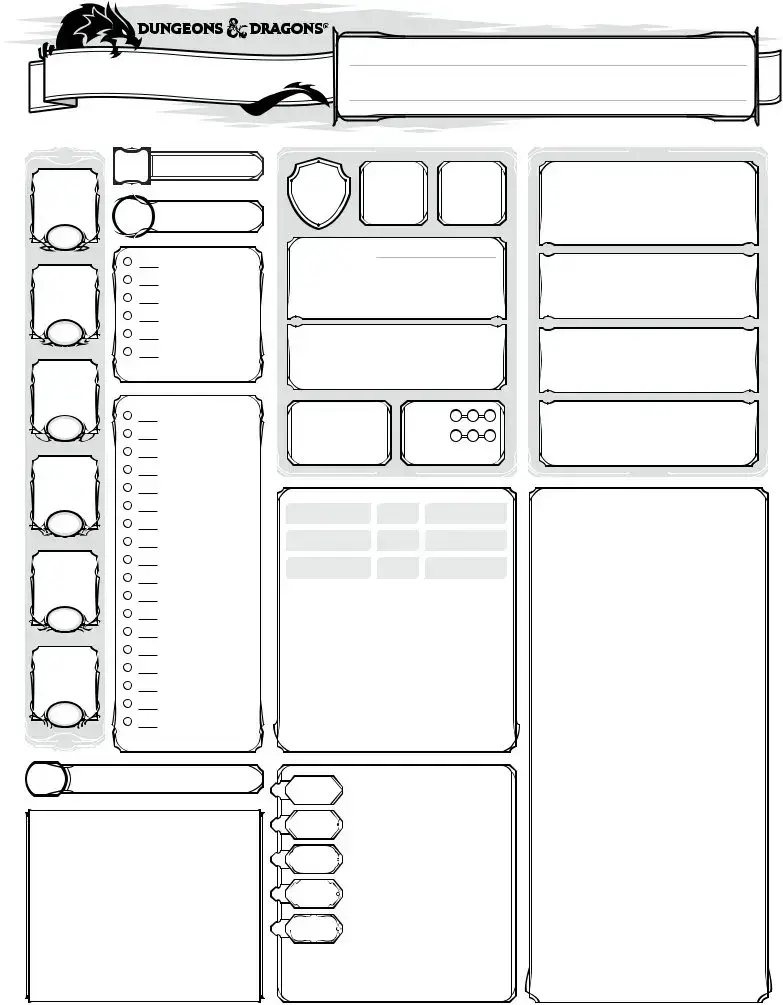
Filling out the Dungeons and Dragons (D&D) Character Sheet is an exciting step in creating your character. This form will help you organize all the important details about your character, from their abilities to their background. Follow these steps to complete the form accurately.
- Start with your character's name. Write it at the top of the sheet.
- Choose a race for your character. Common options include Human, Elf, Dwarf, and Halfling.
- Select a class. This could be Fighter, Wizard, Rogue, or any other class available in the game.
- Determine your character's background. This could be Soldier, Sage, or any other background that fits your character's story.
- Fill in your character's alignment. Choose from options like Lawful Good, Chaotic Neutral, or others.
- Record your ability scores. Roll dice or use a point-buy system to determine Strength, Dexterity, Constitution, Intelligence, Wisdom, and Charisma.
- Calculate your modifiers based on your ability scores. Write these next to the corresponding abilities.
- Fill in your character's hit points. This is usually based on your class and Constitution modifier.
- List your skills and any bonuses you have. This includes things like Stealth, Persuasion, or Acrobatics.
- Choose your equipment. Note any weapons, armor, and other gear your character starts with.
- Write down any spells if your character is a spellcaster. Include spell slots and known spells.
- Complete the personality traits, ideals, bonds, and flaws sections to give depth to your character.
- Finally, review your character sheet for accuracy and completeness.
Common PDF Forms
Da 7666 - An important tool in addressing soldiers’ concerns within the Army.
CBP Declaration Form 6059B - The form includes sections for declaring food, plants, and animals brought into the U.S.
A Colorado Motorcycle Bill of Sale form is a legal document that records the sale and transfer of ownership of a motorcycle between a buyer and a seller. This form serves as proof of the transaction and includes essential details such as the motorcycle's make, model, year, and identification number. For those looking for a reliable template, you can visit Colorado PDF Templates. Having a properly completed bill of sale can help protect both parties and facilitate a smooth registration process with the state.
Irs 433-f Allowable Expenses - The IRS 433-F provides a snapshot of a taxpayer's financial health.
Dos and Don'ts
When filling out a Dungeons & Dragons (D&D) character sheet, attention to detail can significantly enhance your gaming experience. Here are some helpful tips on what to do and what to avoid.
- Do read the Player's Handbook for guidance on character creation.
- Do take your time to understand your character's background and abilities.
- Do collaborate with your Dungeon Master to ensure your character fits the campaign.
- Don't rush through the process; a well-thought-out character is more enjoyable to play.
- Don't ignore the importance of character alignment and how it affects your decisions in-game.
By following these guidelines, you can create a character that not only fits within the game but also enriches the overall experience for you and your fellow players.
Common mistakes
-
Ignoring the Ability Scores: One common mistake is not properly calculating or recording ability scores. These scores are fundamental to your character's capabilities. Double-check your calculations to ensure accuracy.
-
Overlooking Racial Traits: Each race in Dungeons & Dragons has unique traits that can enhance your character. Failing to include these traits can limit your character's potential. Make sure to read the racial description carefully.
-
Neglecting Background Features: The background provides important skills and features. Some players forget to include these on their character sheet, missing out on valuable advantages during gameplay.
-
Incorrectly Selecting Class Abilities: Each class has specific abilities that can significantly affect gameplay. It’s essential to choose the right ones based on your character's level and class type.
-
Forgetting Equipment and Inventory: Players often overlook listing their starting equipment. This can lead to confusion and challenges during the game. Take time to fill out the inventory section thoroughly.
-
Not Keeping Track of Hit Points: Hit points are crucial for survival in battles. Some players forget to update their hit points after taking damage or healing, which can lead to mistakes in gameplay.
-
Misunderstanding Spell Slots: Spellcasters must manage their spell slots carefully. Failing to track used and available slots can hinder a character’s effectiveness in combat and roleplay.
-
Leaving Out Personality Traits: Personality traits help define your character and influence interactions with others. Neglecting to include these can result in a less engaging roleplaying experience.